
What is it about?
Selecting a standards-compliant passivation process for stainless-steel components in aerospace-related applications.
CitriSurf® offers citric-acid-based solutions for passivation and cleaning in the aerospace context.
Aerospace
In aerospace applications, it is not enough to consider stainless steel only as a corrosion-resistant material. The decisive factor is whether the surface can be prepared reproducibly, treated with process reliability and verifiably confirmed within the respective release environment. Free iron contamination, processing residues, weld zones or residues from upstream production steps can influence the surface and become relevant in quality-critical applications.
There is a clear technical framework for this step. In the aerospace context, AMS 2700, ASTM A967 and ASTM A380 are particularly relevant. They define the normative reference for procedures, surface preparation and verification. The decisive question is therefore not whether passivation is permitted, but which standards-compliant procedure is the right choice for the component, process and release context.
CitriSurf® offers citric-acid-based solutions for different process scenarios, from local treatment of weld seams and large components to reproducible bath processes.
Selecting a standards-compliant passivation process for stainless-steel components in aerospace-related applications.
Whether local application, a bath process or low-foam process control fits the specific component and intended production.
AMS 2700, ASTM A967 and ASTM A380; for fasteners, additionally ISO 16048 depending on the application.
When a citric-acid-based passivation process is required that can be classified in relation to component and process and verified under real conditions.
Aerospace
Even corrosion-resistant stainless steel is not automatically process-ready. In practice, processing, welding, transport, assembly or insufficient pre-cleaning can create surface conditions that must be assessed and, if necessary, treated. Passivation serves to remove free iron contamination from the surface and support the natural passive layer of the material.
In the aerospace environment, however, this step is not viewed in isolation. It is connected with cleaning strategy, manufacturing sequence, test methodology, documentation and release process. For decision-makers, the product name is therefore not the first relevant point; the key question is whether the process can be introduced in a controlled way, verified and operated with long-term stability.
Decisive for decision-makers:
Not "Which chemistry is available?", but "Which process can be used reliably for the component, standard reference and release context?"
Aerospace
AMS 2700
AMS 2700 is the central aerospace-related reference for the passivation of corrosion-resistant steels. The specification is particularly relevant when a process must be clearly classified, documented or released in the aerospace context.
ASTM A967
ASTM A967 describes chemical passivation treatments for stainless-steel parts and includes different treatment types as well as testing options to confirm effectiveness. The standard is particularly important when procedures are evaluated in terms of evidence and verification.
ASTM A380
ASTM A380 is the essential companion reference for cleaning, descaling, pickling and passivation of stainless-steel parts, assemblies, plants and systems. It is especially relevant where passivation is understood as part of clean surface preparation.
ISO 16048
ISO 16048 is not generally relevant for all stainless-steel parts. It becomes important especially when fasteners made of corrosion-resistant stainless steel are considered.

Aerospace
Local application
Local passivation is often useful when weld seams, vertical surfaces, large assemblies or hard-to-access areas need to be treated and a conventional immersion process is technically or economically impractical.
Bath or tank process
A bath process is often useful when recurring workflows, series components and standardized, reproducible process control are the focus.
Low-foam process control
Particularly low foam formation can become relevant when the system design or media movement requires it.
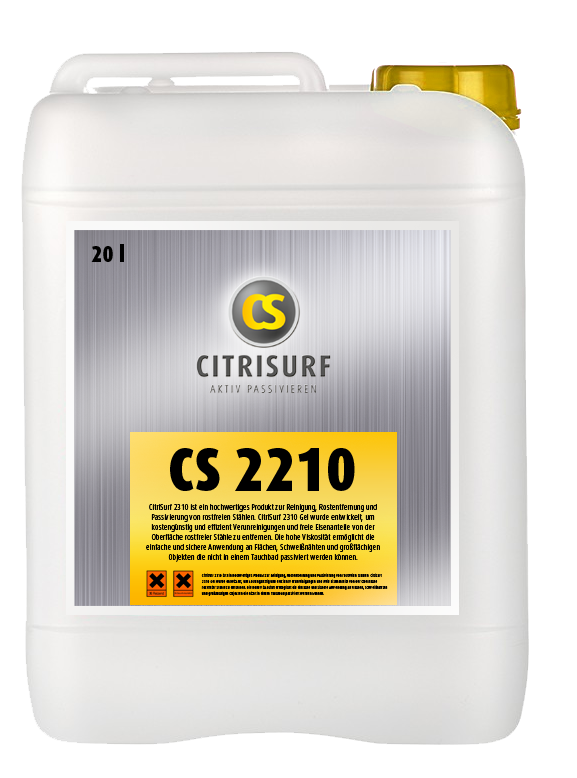
CitriSurf® 2210 is usually the first sensible starting point.
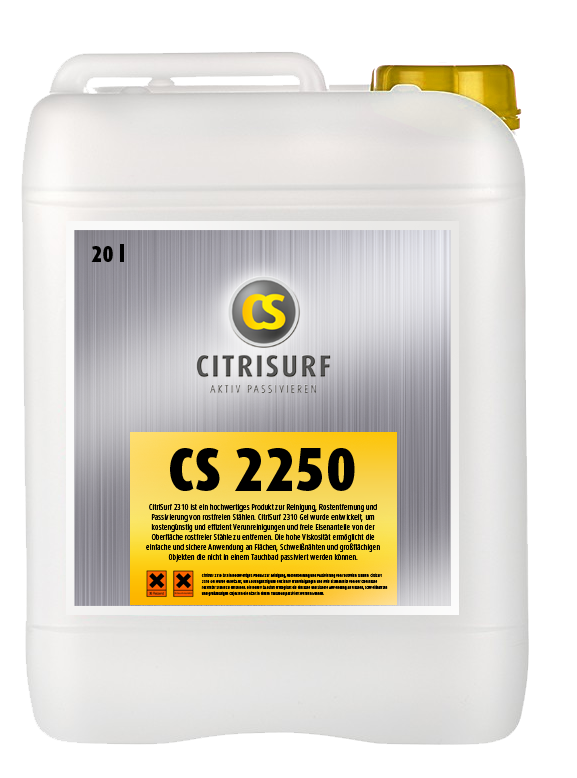
CitriSurf® 2250 is often the suitable basis.
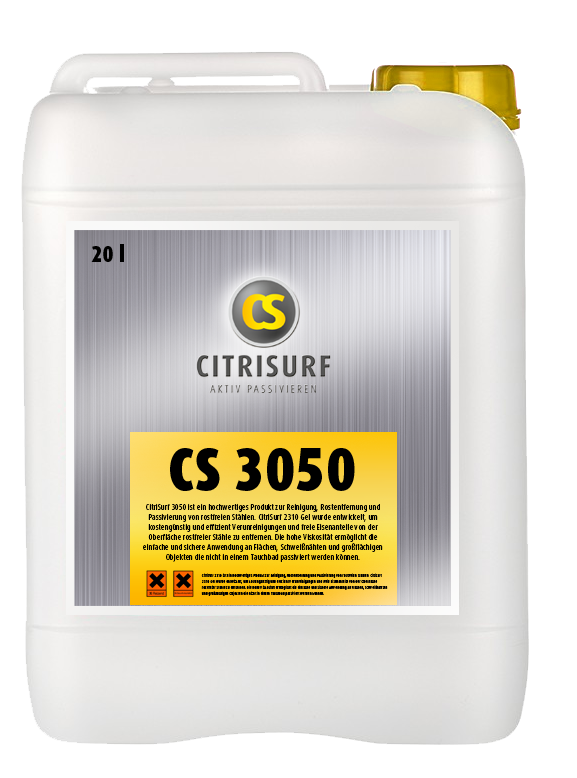
CitriSurf® 3050 should be evaluated.
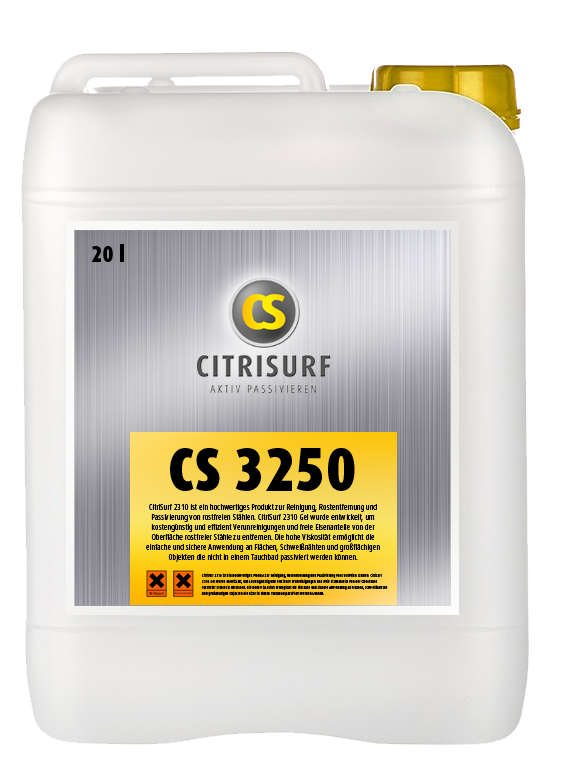
CitriSurf® 3250 should be evaluated.
Aerospace
For applications where local treatment is more appropriate than a conventional immersion process. Particularly relevant for weld seam zones, vertical surfaces, large components and hard-to-access areas.
Typically useful for:
Liquid solution for universal bath and tank processes. Particularly suitable when recurring workflows, series components and controllable, reproducible process control are the focus.
Typically useful for:
Designed for applications where very low foam formation is required.
Typically useful for:
Foam-reduced solution for applications with martensitic stainless steels. Particularly relevant when
Typically useful for:
Important:
Suitability should be tested on the specific component and under real conditions before production use. According to the product page, CitriSurf ® 3250 is not intended for automatic cleaning systems.
The decisive point remains:
Product selection should not be made in isolation on the basis of a data sheet. The material, geometry, pretreatment, contamination pattern, process control, testing requirement and release context are decisive.
Aerospace
How to prepare a reliable decision
Material, manufacturing condition, surface condition, weld proportion, geometry and relevant standard or customer requirements are recorded.
It is assessed whether local application, a bath process or a low-foam solution better fits the application case.
Reliable passivation requires a clean starting condition. Oil, grease, heat tint or other residues must be considered in the process concept.
Concentration, temperature, time, media movement, rinsing concept and drying are adapted to component and process.
Depending on standard reference and release context, the result is tested and documented using suitable test methods.
Before regular production use, suitability should be confirmed traceably on the specific component and under real process conditions.
Aerospace
Why CitriSurf® is relevant in the aerospace context
Decision-makers in aerospace are rarely looking simply for passivation chemistry. They are looking for a process that can be integrated into existing or newly established processes while remaining technically traceable, normatively classifiable and cleanly verifiable.
This is precisely where the strength of CitriSurf® lies:
a citric-acid-based approach to stainless-steel passivation, different formulations for local treatment, bath processes and low-foam applications, and component- and process-related preselection instead of purely generic product recommendations.
The better question is not:
Is CitriSurf® generally suitable?
The better question is:
Does CitriSurf®, in the right formulation, fit our component, our process and our release context?
FAQ
No. The standard sets the framework, but not automatically the best implementation for every component or process line. Geometry, surface condition, process control, verification and release context are also decisive for selection.
When weld seams, large assemblies, vertical surfaces or hard-to-access areas need to be treated and an immersion process is not the most useful approach.
When series components are treated with recurring workflows and reproducible, standardizable process control is the focus.
No. A data sheet is an important starting point, but it does not replace assessment of the real application case. Suitability should always be checked on the specific component and in the real process.
When local treatment is required, especially on weld seams, vertical surfaces or large components.
When a universal bath process is to be established for recurring applications and series components.
When very low foam formation is relevant for the intended process.
Are you looking to passivate stainless steel components for aerospace applications and need a reliable preliminary selection? If so, you should first determine which standard applies, the geometry of the components, the intended process, and how verification will be conducted. Based on this information, a suitable CitriSurf® process can be technically identified.
We can assist you in determining whether a product is intended for local application or bath processing, evaluating weld zones and complex assemblies, selecting among different CitriSurf® formulations, conducting a preliminary technical assessment with regard to relevant standards, and requesting data sheets and product samples.
Exclusively from MKK GmbH, Oldenburg
Order by email: order@citrisurf.de
Please note:
- Provide your VAT ID
- Billing address and delivery address required
- Orders before 12:00 noon: usually shipped on the next working day
- Delivery date = shipping date (transit times depend on the logistics provider)